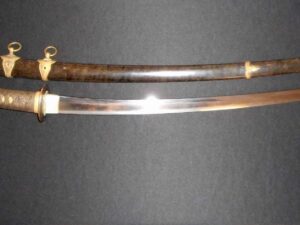
-
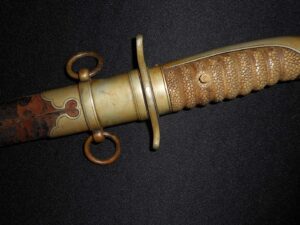
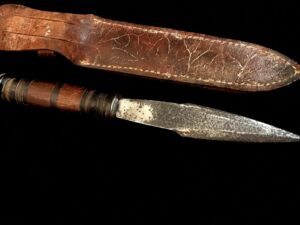
Japanese FORESTRY DIRK -Sword WW II -Old/Antique Samurai/Dagger -LARGE! -Rare

Japanese FORESTRY DIRK -Sword WW II -Old/Antique Samurai/Dagger -LARGE! -Rare
$0
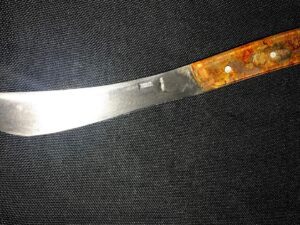
1 rare late 1800’s thru World War II Japanese Samurai Forestry Dirk available. This is a rare Japanese dirk–it is unusual to find a large, early Forestry dirk. This dagger would make an exceptionally rare addition to any collection.
The blade measures 16 11/16″ (42.4 cm). This dagger measures 22″ overall (55.9 cm).
The blade is a handmade oil- or water-tempered blade. The nakago is not signed.
This is a rare variation Forestry dagger.
-
Old WW2 Samurai Sword -Antique Japanese WW II Navy/Naval MASAHIRO/Takayama Forge
Old WW2 Samurai Sword -Antique Japanese WW II Navy/Naval MASAHIRO/Takayama Forge
$0
1 desirable Japanese World War II Takayama Forge Navy Officer’s Samurai sword available. This desirable katana was made by Hattori Masahiro. This Japanese sword would make an important addition to any collection.
Swords made at the Takayama Forge are highly collectible. In addition, Masahiro made swords in a distinctive ‘old way’. He made swords with a kissaki that is two times thicker at the mune than normal. During World War 2, only Masahiro (at the Takayama Forge) made swords with this type of kissaki. This type of sword tip was made to reduce the likelihood of a break or chip at the blade tip. A sword made by Masahiro is very desirable.
There are an unusually high number of kanji on the nakago. There are 17 kanji on the tang. The nakago/tang is signed ‘Kin Saku Takayama to Hattori Masahiro‘. The lower left side of the nakago is signed with the polisher’s name. The oil-tempered ‘no rust steel’ blade measures 24 1/8″ (61.3 cm) from blade tip to notch in the blade spine. The nakago has a Naval anchor stamp. An additional distinguishing feature of a Masahiro blade is the distinctive ratio of nakago length to overall sword length.
Masahiro was the ONLY Japanese WW2 swordsmith to make swords with these many distinguishing features.
The tsuka has sharkskin under the silk wrap. The saya is made of premium sharkskin as well.
All fittings have matching assembly numbers. The number stamped on each fitting is ‘528‘.
-
Japanese WW2 Samurai Sword -Old/Antique WW II Army BIGGEST SWORD YOU WILL EVER SEE
Japanese WW2 Samurai Sword -Old/Antique WW II Army BIGGEST SWORD YOU WILL EVER SEE
$0
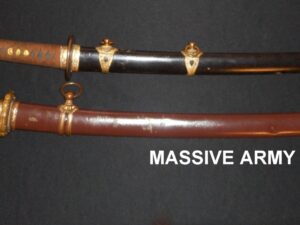
1 large antique World War II Japanese Samurai Army Officer’s sword available. This is the biggest WW2 Army sword a collector will ever run across. An Army Officer sword of this size is exceedingly rare.
This sword was made by Minamoto Masauji. This Japanese Army gendaito sword would make an important addition to any collection.
This sword is signed ‘Minamoto Masauji saku kore’. The reverse side of the nakago is dated ‘November 1936’. This is about the earliest date to be found on a shin-gunto sword.
The blade measures 27 9/16″ (70 cm)–as measured properly with a tape pulled tight from the blade tip to the bottom of the notch in the habaki. This sword measures 43″ from blade tip to the end of the handle. The tsuka/handle on this sword is oversized–it measures 12 1/4″ (50% longer than the typical regulation Army tsuka).
This sword has an undulating, water-tempered hamon/temper line.
The fittings have matching assembly numbers on them–all fittings are stamped ’40’. The tsuba is the large over-sized variation.
The kashira has a Samurai family mon. This mon is the family crest of the Shizume Samurai clan.
-
Japanese WW2 Samurai Sword -Old/Antique WW II Army CAPTURE TAG/GENDAITO/1ST SEAT
Japanese WW2 Samurai Sword -Old/Antique WW II Army CAPTURE TAG/GENDAITO/1ST SEAT
$0
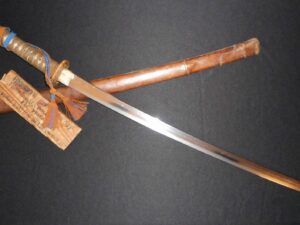
1 antique World War II Japanese Samurai Army Officer’s sword available. This sword was made by Sanyo Miyumisanroku ju Fujiwara Kazunori. Kazunori earned 1st Seat at the 1941 Sword Exhibition. This Japanese Army gendaito sword would make an important addition to any collection.
This sword is signed ‘Sanyo Miyumisanroku ju Fujiwara Kazunori saku kore’. The reverse side of the nakago is dated ‘2601 Years After Founding of the Empire‘. This date translates to 1941.
The blade measures 26 3/8″ (67 cm)–as measured properly with a tape pulled tight from the blade tip to the bottom of the notch in the habaki.
This sword has an undulating, water-tempered hamon/temper line.
The fittings have matching assembly numbers on them–all fittings are stamped ‘3’. The regular metal Army saya has a leather combat cover over it. This sword has a fine blue/brown Company Grade tassel.
The original surrender tag is attached to the saya. The original soldier’s information is written in both Japanese and English. It is very unusual to have a Japanese soldier who could write in English as well. The surrender tag reads ‘Hyogoken Hikamigun Oji-mura Nakayama, Mr. Murakami, Kuroi Station in Fukuchiyama Lin‘.
-
Japanese Colonial CHOSEN Sword -WW II KOREA -Antique/Old WW2 Military/Samurai
Japanese Colonial CHOSEN Sword -WW II KOREA -Antique/Old WW2 Military/Samurai
$0
1 fine Japanese WW2 Chosen (Korea) Colonial Sword available. This sword would make an important addition to any collection.
This is the Sonin (higher) level sword with decorated fittings.
The sword blade measures 25 1/2″ (64.8 cm).
-
WW II Japanese YASUKUNI SHRINE Army Officer Samurai Sword -Antique/Old Collection
WW II Japanese YASUKUNI SHRINE Army Officer Samurai Sword -Antique/Old Collection
$0
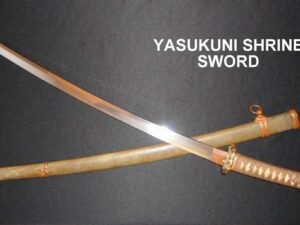
1 desirable Japanese antique available. This Japanese World War 2 Yasukuni Shrine Army Officer sword would make an important addition to any collection.
This sword was made by the Yasukuni Shrine smith Kotani Yasunori.
The saya is very desirable–it is a rare Army saya with same/rayskin. A rayskin army saya is found on 1 in 10,000 army swords–so this sword with its rayskin saya is exceedingly rare.
The blade measures 26 7/8″ (68.3 cm) from blade tip to notch in the blade spine.
-
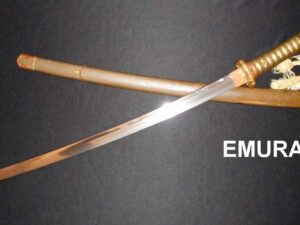
Japanese WW2 Samurai Sword -Old/Antique WW II Army -EMURA -Gendaito Collection
Japanese WW2 Samurai Sword -Old/Antique WW II Army -EMURA -Gendaito Collection
$0
THIS SWORD SHIPS FREE TO ANYWHERE IN THE WORLD!
1 antique World War II Japanese Samurai Army Officer’s sword available. This sword was made by Emura. This fine Japanese Army katana would make an important addition to any collection.
The blade measures 26 1/4″ (66.7 cm)–as measured properly with a tape pulled tight from the blade tip to the bottom of the notch in the habaki.
The hamon is complex–a fine hamon not surprising for a smith of Emura’s skill level.
The fittings have matching assembly numbers on them–all fittings are stamped ‘430’.
-
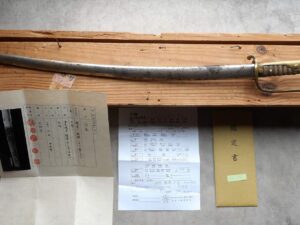
Koto Japanese Samurai Sword -Russo w/BRINGBACK PAPERS & BOX -Papered/Antique
Koto Japanese Samurai Sword -Russo w/BRINGBACK PAPERS & BOX -Papered/Antique
$0
THIS ITEM SHIPS FREE TO ANYWHERE IN THE WORLD!
1 exceptional antique Japanese Samurai sword available. The blade itself was carried by Samurai from 1469-1487 A.D. up through World War 2. This desirable Japanese antique would make an important addition to any collection.
This sword has extraordinary history helping to make it an exceptional Japanese antique. The sword is an old Samurai blade–remounted during the Russo-Japanese War.
The blade is signed, and has 4 holes. I had the sword papered by the NTHK-NPO. The sword is papered to Echizen Fujiwara Tsuguiye. He worked during the Bunmei period of Japan–1469-1487 A.D.
The hamon is hard to photograph, because the blade is all scratched up. In person, one can see a beautiful wavy hamon. The hamon is somewhat flat and then has periodic peaks. The quality of the blade is confirmed by the papers–and by the 20 pt. rating for Tsuguiye in Hawley’s book.
The blade measures 24 1/8″ (61.3 cm) from blade tip to the habaki. The end of the tsuka/handle has a Samurai family mon.
This sword has its original bringback box–the box that the U.S. soldier mailed the sword back home in. On top of the box is a paper card reading ‘CERTIFICATE’ attached with tacks. Under the paper card was found the original bringback paper.
The handle is covered in polished rayskin–a higher class handle finish.
-
Antique Japanese Samurai Kusarigama Sickle & Chain -Old Katana Sword Collection
Antique Japanese Samurai Kusarigama Sickle & Chain -Old Katana Sword Collection
$0
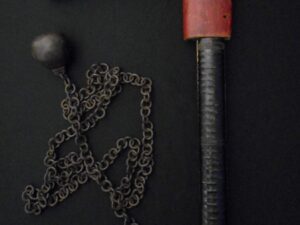
1 antique Samurai kusarigama (sickle and chain) weapon available. This Samurai weapon was made sometime in the 17th or 18th centuries. This hard-to-find Japanese antique would make an important addition to any collection.
Use of the kusarigama is called kusarigamajutsu. Attacking with the weapon usually entailed swinging the weighted chain in a large circle over one’s head, and then whipping it forward to entangle an opponent’s spear, sword, or other weapon, or immobilizing his arms or legs. This allows the kusarigama user to rush forward and strike with the sickle.
A kusarigama wielder might also strike with the spinning weighted end of the chain directly while still outside the range of an opponent’s hand weapon.
There are great videos of martial artists practicing kusarigamajutsu on youtube.
This kusarigama measures 16 1/2 inches in length. The chain measures 61 inches.
-
Japanese WW II SOUTH MANCHURIAN RAILWAY Sword -HISAKATSU/Antique/WW2 MANTETSU
Japanese WW II SOUTH MANCHURIAN RAILWAY Sword -HISAKATSU/Antique/WW2 MANTETSU
$0
1 rare Japanese WW2 military sword available. This important sword was made by Hisakatsu. Hisakatsu was the forging instructor for the early prototype South Manchuria Railway ‘SMR’ logo marked swords, and for the ensuing Koa Isshin Mantetsu swords. Very rare–a sword that helps complete the Mantetsu line of swords in one’s collection.
His original name was Takeshima Masao, born February 28, 1909. He learned swordmaking from Horii Toshihide in Zuisen Tantosho in 1926, and founded his own forging center at Yamaguchi Prefecture in 1934. He was the winner of the Shinsaku Nihonto Daikyoshinkai Yushusho and the 1st Nihonto Denrankai Tokusen and Honorary President Award in 1935. In the next year, he won the Ministry Award at the 2nd competition. In 1938, he went to Manchu Railway Ltd., and directed the production of Koa Isshin Mantetsu blades.
Note the habaki has the same numbering as on the South Manchurian Railway swords. (See photo below). Note too the deep red color to the fittings–the same early fittings found on the prototype SMR swords. The sword is dated using the zodiacal dating system–like on the Koa Isshin Mantetsu blades.
The sword is signed ‘Nanjino Reito Minamoto Hisakatsu saku’. ‘Nanjino Reito’ means ‘Your Spiritual Sword‘.
This sword measures 26 1/4″ (66.7 cm) from blade tip to the notch in the blade spine.
-
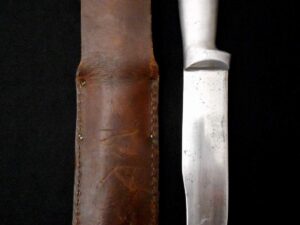
RARE! WW2 Baker Knife Custom Fighting -US Combat Dagger Collection/Leo/L -WW II
RARE! WW2 Baker Knife Custom Fighting -US Combat Dagger Collection/Leo/L -WW II
$0
1 rare U.S. World War II Baker fighting knife. This hard-to-find knife by Leo Baker would make a rare addition to any collection.
This is a rare design Leo Baker fighting knife. It would be just nigh on impossible to find another.
You can see Baker WW2 fighting knives on pages 78-80 of Mike Silvey’s book Knives of the United States Military–World War II. Photo 6 above is page 80 in Mike Silvey’s book. There is additional reference information in Bill Walter’s book U.S. and Allied Military Knives — World War II on pages 58-60.
This fine combat knife is stamped on the blade ‘L. BAKER‘. Leo Baker made his fighting knives using old files. You can still see the file marks on the blade.
The handle is made of wood, black, leather, and lead. This knife has a steel guard, and a lead pommel. This knife measures 10 13/16″ overall. The blade itself measures 6 1/16″.
-
WWII RICHTIG Fighting Knife -FJR Clarkson Neb/Nebr -US Combat Collection/Military
WWII RICHTIG Fighting Knife -FJR Clarkson Neb/Nebr -US Combat Collection/Military
$0
1 fine Frank J. Richtig World War II fighting knife available. This fine WW2 Richtig fighter would make a rare addition to any knife or military collection.
This Richtig WW2 fighting knife has a 6″ blade. This Richtig fighter measures 10 3/4″ overall. The handle is stamped ‘F.J.R. CLARKSON NEB.’.
This listing represents a rare opportunity to own a knife by a maker that Presidents and generals have been proud to own. M.H. Cole in his book The Best of U.S. Military Knives Bayonets & Machetes wrote, ” SOME OF RICHTIG’S SATISFIED CUSTOMERS WHO HAD SENT HIM LETTERS TO THAT EFFECT, ARE GEN. GEO. PATTON, GEN. DOUGLAS MACARTHUR, GEN. DWIGHT EISENHOWER, & FRANKLIN ROOSEVELT, ADMIRAL CHESTER NIMITZ, AND OTHER NOTABLES .”See photo 2 above from Mike Silvey’s book Knives of the United States Military World War II.
-
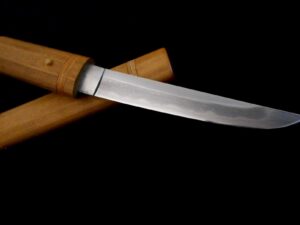
Japanese WWII Army Tanto Dagger -Old Antique WW2 Samurai Sword Collection
Japanese WWII Army Tanto Dagger -Old Antique WW2 Samurai Sword Collection
$0
1 antique WW2 Japanese Army tanto available. Tanto swords like this one were carried by Japanese soldiers during World War II to evoke for them the spirit of the Samurai. This Japanese tanto would make an important addition to any collection.
This tanto could be easily carried in a pack. The blade measures 5 3/16″. The nakago/tang is not signed. When in its shirasaya, this tanto measures 9 1/8″ overall. This Army tanto was a wavy temper line.
-
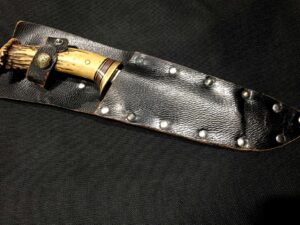
Antique W SCAGEL Fighting Knife -Old VL&A Chicago/Hand Made -Stag -William
Antique W SCAGEL Fighting Knife -Old VL&A Chicago/Hand Made -Stag -William
$0
1 rare original Scagel fighter knife available. This original William Scagel knife would make an important addition to any premium collection.
This knife was sold in the James D. Julia Dr. Lucie Scagels auction. This knife was featured on page 197 of the Julia auction catalog. This knife also appears on page 144 of Scagel Handmade by James R. Lucie. The sheath appears on page 64 of Dr. Lucie’s book.
This knife was described in the catalog as the Rare “Swelled Tip” Style Scagel Fighter.
This Scagel has aluminum, black, and red spacers. This knife has a brass guard, and a crown stag handle.
This rare Scagel measures 12″ overall. The blade measures 7″. The front side of the blade is stamped ‘W. SCAGEL HANDMADE‘, as well as the Scagel kris stamp. The reverse side of the blade has the ‘V.L.&A. CHICAGO‘ stamp.
-
Antique W SCAGEL Theater Fighting Knife -Old WW2 WW II -William/Bill
Antique W SCAGEL Theater Fighting Knife -Old WW2 WW II -William/Bill
$0
WE BUY SCAGEL KNIVES. USE THE ‘CONTACT US’ FORM ABOVE, EMAIL US AT INFO@STCROIXBLADES.COM, OR CALL US AT 715-557-1688.
1 rare original Scagel fighting knife available. This original William Scagel knife would make an important addition to any premium collection.
This theater Scagel was carried in World War 2. This Scagel started out as a skinning knife. In the first almost two years of the War, hunting knives were sent over with our G.I.’s, because the United States military wasn’t prepared to outfit millions of U.S. soldiers with fighting knives. There were knife donation drives for the War effort. During the War, a G.I. changed the handle scales on this knife to aircraft windshield plexiglass salvaged from downed aircraft. Note the handle pins are made of aluminum.
Theater knives are fighting knives made by soldiers in the field, or by craftsman here at home for soldiers. Knives made by soldiers were often made with materials that were readily available to them–like plexiglass spacers made from enemy aircraft windshields, aluminum, brass, leather, and blades or handles from Issue fighting knives.
The blade measures 5 1/2″. The front side of the blade is stamped ‘W. SCAGEL HANDMADE‘, and is stamped with the Scagel kris stamp.
-
Antique W SCAGEL Handmade Carving Knife -Old Carver -William/Bill
Antique W SCAGEL Handmade Carving Knife -Old Carver -William/Bill
$0
Have a Scagel knife to sell? WE BUY SCAGEL KNIVES. USE THE ‘CONTACT US’ FORM ABOVE, EMAIL US AT INFO@STCROIXBLADES.COM, OR CALL US AT 715-557-1688.
1 rare original Scagel carver available. This original William Scagel knife would make an important addition to any premium collection.
The knife measures 15″ overall. The front side of the blade is stamped ‘W. SCAGEL HANDMADE’, and is stamped with the Scagel kris stamp.
-
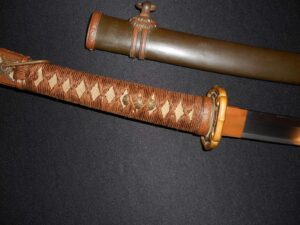
Antique MURATA Japanese Sword -WW II/Old WW2 Muratato Samurai TACHI -Tassel
Antique MURATA Japanese Sword -WW II/Old WW2 Muratato Samurai TACHI -Tassel
$0
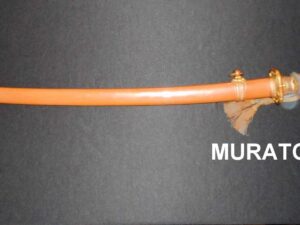
1 antique World War II Japanese Samurai army officer’s Muratato shin-gunto sword available. A sword in this condition would make an important addition to any collection.
The tang has stamped kanji. Murata Tsuneyoshi developed the “new Japanese-European combined sword system”.
All military fittings are of excellent quality. The seppa, tsuba, etc. all have the matching assembly numbers ’25’. The blade measures 26 1/8″ from blade tip to notch in the blade spine. This fine sword has a metal brown/red-lacquered scabbard.
This Muratato has a pierced tsuba. The handle/tsuka has a tachi curvature to it.
This sarute/tassel loop has a blue/brown company grade tassel.
Here is information from Ohmura’s studies:
Murata-tō
Tsuneyoshi Murata an army Major General Baron, is the expert of shooting. He developed the famous “Murata Rifle”.
Then, he aspired after improvement of a Guntō and made the Guntō to the trial himself using the saber metal (sword
steel of German Solingen) of stock of the Tokyo Artillery Arsenal.
Since this sword cut very well, he completed the blade which instruction of Kanenori Miyamoto, Sukekane Yokoyama, etc.
was received, Sweden steel and a Japanes steel ratio were dissolved by 6 to 4, and he dissolved mincement and this at
1,500 degrees C, and carried out One-piece forging (Ichimai-Gitae) and carried out oil hardening. The bone of the head
of a pig was splendidly cut in October, Meiji 24 (1891) using two blades by the sharpness examination in an Arsenal.
Since there were no abnormalities in two blades, it depended on this result and this blade was adopted as the Guntō.
This blade was cheap, since an officer was also easy to come to hand, it was greatly used by Nissin and the
Russo-Japanese War, and it was proved that it was the practical use Guntō strongly turned off well to rust.
This blade was manufactured in the army “Tōkyō Artillery Arsenal (Tōkyō Hōhei Kōshō)”
The Mei cut with a “Shōjū (Rifle)-Kanemasa”, carried out the archaic script of the 4 characters of the Tsuneyoshi
Murata to the bottom of it, and struck the stamp compounded to 2 characters.
Name of an era and the serial number are stamped on the reverse side of a Tang.
In addition, the Mei of “Kanemasa” or “Murata Tsuneyoshi ” was cut by the sword which Tsuneyoshi Murata forge himself.
In order that there might be no “Hamon” in the mass-produced blade, evaluation of a sword community was not obtained.The blade which Yoshitsune Murata forge himself
Blade length: 83.185cm. Edge length: 66.357cm. Tang length: 16.827cm. Curvature(Sori): 0.714㎝
The blade style is “Kogarasumaru”. It seems that Hamon was drawn by etching. All the blades that he forge cannot be
found by this type. It seems that there was much ordinary structure. Three Mekugi holes mean that the Shirasaya, the
saber, etc and the Koshirae changed.
It was dedicated by the Type-98 Koshirae, without touching a Mekugi hole. For the reason, Habaki has twice as many
ordinary length as this due to a Mekugi hole.(Photograph offer:Mr.Frank Stand in U.S.A)
“Mukade-giri-maru”which the Tsuneyoshi Murata made the model of the Murata-tō.
Mukade-giri-maru: 1000 or more are a front Tachi.
The celebrated sword of the tradition said for the Hidesato Fujiwara to have received from Ryūjin. Now, this Tachi is
a treasured sword of the Ise Shrine. Major General Murata made this Mukade-giri-maru the model of the Murata-tō.His Imperial Highness Prince Chichibu’s practice sword (reserve)
Edge length: 66.7cm. Curvature(Sori):1.6㎝
← Mei: The Tachi for Guntō way practice was imitated.
This was manufactured in Tōkyō Artillery Arsenal
Ura Mei: August, 1933 lucky day Serial № 116 →
Tōkyō Artillery Arsenal trademark stampWhen it guessed from a Mei and Emperor Taishō’s second Imperial prince
(next Prince Chichibu) entered a military academy, this sword was
presented to practice of the Guntō.The Murata-tō which imitated the Mukade-giri-maru was presented to the Imperial-Family officer. There is no telling
who did the sword making when. After Major General Murata retired, this sword was modeled on the Tachi which the
Imperial-Family officer was using for practice of a Guntō, and was forged.
It is a precious sword which can check the figure of the sword of the starting point of the Murata-tō.Mass-production Murata-tō
Edge length: 61.5cm. Curvature(Sori): 0.9cm. Hi (Slot) which pierced through all blades and Middle-Kissaki.
← Mei; Shōjū (Rifle)-Kanemasa
Ura Mei: October, Meiji 23?(1890?) →
Serial № 7-17Hard to read this sword tang Mei(signature) because the tang is
rusty. Furthermore, an exact period cannot be read because of a
Mekugi hole.
If 1890 (?) years are right, it will be called the trial production
blade or a trial production mass-production blade before the army
adoption in 1891.
The stamp which compounded the archaic script of the Tsuneyoshi
Murata to two characters is not found.
-
SIGNED—WW2 Japanese IJN Naval Officer Samurai Sword -Old/Antique Collection
SIGNED—WW2 Japanese IJN Naval Officer Samurai Sword -Old/Antique Collection
$0
1 antique World War II Japanese Samurai Navy Officer’s kai-gunto sword available. This sword would make an important addition to any collection.
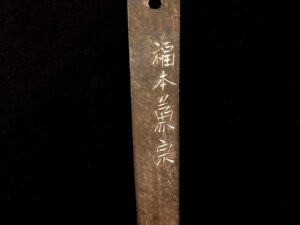
This sword is signed. This sword was made by Fukumoto Kanemune. There is no arsenal stamp on the tang/nakago, so this may be a gendai sword. At the very least though, this sword will be oil-tempered.
The blade measures 22 1/2″ (measured properly from blade tip to the bottom of the notch in the habaki).
This sword has a black leather combat combat cover over its wood saya. Some collectors refer to these swords as Naval Landing Forces swords.
-
SIGNED—WW2 Japanese Army Officer Samurai Sword -Old Collection -SURRENDER TAG
SIGNED—WW2 Japanese Army Officer Samurai Sword -Old Collection -SURRENDER TAG
$0
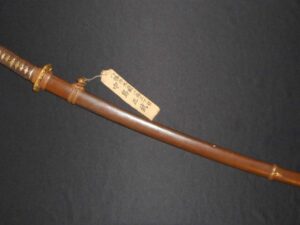
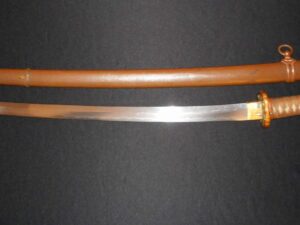
1 antique World War II Japanese Samurai Army Officer’s shingunto sword available. This WW2 Japanese Army katana has the Japanese Officer’s surrender tag attached to the saya. This sword would make an important addition to any collection.
This WW2 Army Officer shin-gunto katana is signed. This sword was made by Kanetsugu. There is a showa stamp over the signature.
The blade measures 25 1/16″ (63.7 cm) from blade tip to notch in the blade spine.
This sword has a desirable sanbonsugi ‘three cedars’ hamon/temper line. This sword has a fine monkey hands sarute/tassel loop.
A canvas surrender tag is attached to the saya. These tags were attached to their swords by the Japanese Officers who surrendered them. They hoped to get them back sometime after the War. This surrender tag has been translated. The Army Officer that surrendered this sword was Nakajima Masataka. His name appears on the left side of the surrender tag; his address appears on the right side. The address translation is a little choppy, but generally reads hachi hanshi shi dai so nishu san tei me.
-
WW2 Japanese Army Officer Samurai Sword/Old WW II Shin-gunto -4TH SEAT KANEYOSHI
WW2 Japanese Army Officer Samurai Sword/Old WW II Shin-gunto -4TH SEAT KANEYOSHI
$0
1 antique World War II Japanese Samurai Army Officer’s shin-gunto sword available. This maker of this sword, Kaneyoshi, was awarded 4th Seat at the 1941 Japanese Sword Exhibition. This sword would make an important addition to any collection.
The blade measures 26 1/8″ (66.4 cm) from blade tip to notch in the blade spine. There is a showa stamp above the signature.
This sword has a desirable wavy temper line/hamon.
This sword has a higher grade pierced tsuba. Additionally, the saya has the high grade spatter-lacquer finish.
-
Japanese Samurai Yanone Arrow Point/Antique Sword Collection ROPE CUTTER Yajiri
Japanese Samurai Yanone Arrow Point/Antique Sword Collection ROPE CUTTER Yajiri
$0
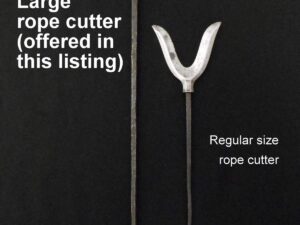
1 antique Japanese samurai arrow point available. This desirable exceptionally large size Japanese rope cutter arrowhead would make a fine addition to any collection.
The ancient 16th-18th century Japanese yajiri/arrowpoint was used by true Samurai. This large arrowpoint measures 13 3/8″ (34 cm), including the tang. The point itself measures 3 1/8″ (7.9 cm) by 2 1/2″ wide (6.4 cm).
-
Kasama SHIGETSUGU Gendaito Sword -HORIMONO -Antique Japanese Katana -Old Samurai
Kasama SHIGETSUGU Gendaito Sword -HORIMONO -Antique Japanese Katana -Old Samurai
$0
1 antique Japanese katana available. This sword is signed ‘Amahide’, is stamped with a kokuin, and is dated 1820. The 2.5 Million Yen swordsmith, Kasama SHIGETSUGU, actually made this katana. Upon conferring with one the top gendaito experts in the United States, it is our opinion that this sword was made by Shigetsugu–this opinion can either be proven or disproven by submitting this sword to shinsa. Shigetsugu is known to have made many gimei swords of master smiths–like Amahide (actually Masahide, but late in life Masahide gave his smith name Amahide to his grandson). Swords made by the master swordsmith Kasama Shigetsugu are quite valuable.
On page 160 of John Slough’s book, Shigetsugu’s work is described as follows:
“Shigetsugu was a master at horimono, and there are many swords with superb examples of his work. He was skilled at producing the Bizen style of choji midare, and also a slightly slanted saka gunome choji.”
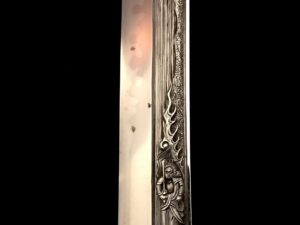
This sword’s nagasa is 27 5/16 inches (69.4 cm). The horimono on this sword is among the best work I have ever seen.
The skill level of Shigetsugu is proven in this sword. The forging work is superior.
-
WW2 Japanese Samurai Sword/Antique Naval SUETSUGU SHIGEMITSU -Sharkskin Gendaito
WW2 Japanese Samurai Sword/Antique Naval SUETSUGU SHIGEMITSU -Sharkskin Gendaito
$0
1 antique World War II Japanese Samurai Navy Officer’s kai-gunto sword available. This WW II gendaito sword was made by a top rated smith. This sword would make an important addition to any collection.
This gendai sword is signed Tsukushi Suetsugu (Suetsugu SHIGEMITSU).
Suetsugu Shigemitsu was awarded the honorary ranking ‘Genro’ by the Nihon Token Tanrenjo (NTT) and the Nihon Token Shinbunshi (NTS) in 1943. Among this small Genro group are the masters: Kasama Ikkansai Shigetsugu, Horii Toshitsugu, Gassan Sadakatsu, Miyaguchi Ikkansai Shigehiro, Watanabe Kanenaga, and Suetsugu Shigemitsu.
The seppa, tsuba, etc. all have the same matching assembly numbers ‘216’. The nakago also has the assembly number ‘216’ stamped on it. This sword has a fine sharkskin saya. This sword has a fine sarute.
The blade measures 26 1/4 (66.3 cm). The hamachi/munemachi blade width measurement is especially wide in this fine sword, measuring almost 1 1/2″ wide.
The hamon is complex–and is commensurate with the skill exhibited in this Genro group.
Please scroll down to the bottom of this listing to view Additional Photos.
-
WW2 Japanese Samurai Sword -WW II IJA Gendaito/Rikugen Jumei Tosho KANETOSHI
WW2 Japanese Samurai Sword -WW II IJA Gendaito/Rikugen Jumei Tosho KANETOSHI
$0
1 antique World War II Japanese Samurai gendai sword in shirasaya. This gendaito (handmade) sword would make an important addition to any collection.
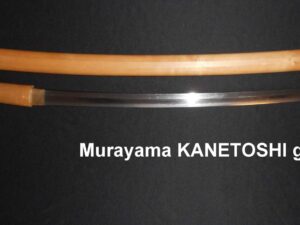
This sword was made by Murayama KANETOSHI. Kanetoshi was a Rikugen Jumei Tosho smith. This is a fine example of his work.
The blade measures 25 11/16″ (65.2 cm) from blade tip to notch in the blade spine. This sword has a visible hada, and was traditionally-made with tamahagane.